
- All
- Product Name
- Product Keyword
- Product Model
- Product Summary
- Product Description
- Multi Field Search
Views: 255 Author: Wanqi Publish Time: 2026-11-26 Origin: Site


Content Menu
● Why Instant Coffee Is a Demanding Application
● How a Two-Piece Induction Liner Works
● Matching the Liner to the Jar Material
● Which Wanqi Liner Fits Instant Coffee?
● Common Mistakes We See in the Factory
● Case Example: Switching From Paperboard to EPE Foam
● FAQ
Instant coffee is hygroscopic. It pulls moisture from the air, clumps, and loses aroma. A cap alone cannot stop this.
An induction seal bonds foil to the jar rim. It gives a hermetic, tamper-evident barrier that outperforms cap-only compression. Coffee is often packed in glass with a foil freshness seal across the opening.
Our engineers see three failure modes most often:
- Moisture ingress leads to caking.
- Aroma loss leads to flat flavor.
- Weak bonding leads to leaks, or to a seal that peels poorly.

A two-piece liner has two parts. The backing (pulp or foam) holds the liner in the cap. The wax layer lets the backing separate from the foil after sealing. The foil stays bonded to the jar.
Sealing steps:
1. Fill the jar and wipe the rim clean.
2. Fit the cap with the liner inside.
3. Pass the jar under the induction sealer.
4. The foil heats and bonds to the rim.
5. The consumer unscrews the cap and peels the foil.
Particulates at the rim cause leaks whatever sealing method you use. Keep the rim clean. [wolf-packing]
This is where most buyers go wrong. The heat-seal layer must suit the container surface. A sealant made for polyethylene may not bond the same way to PET, PP or glass. [objectbrief]
| Jar material | What to specify | Don't assume |
|---|---|---|
| Glass | Liner designed for glass, often adhesive-based sealing layer | Plastic-jar liners will bond to glass |
| PET | PET-compatible or validated multi-resin layer | Any "plastic bottle" liner works |
| PP | PP-verified or validated universal construction | PE compatibility covers PP |
| HDPE/PE | PE sealing layer plus a trial on your bottle | More sealer power fixes poor chemistry |
Glass does not melt at sealing temperatures. The sealing layer is therefore usually adhesive-based.
We make several constructions for coffee. These are the two we recommend most.
1. Paperboard + foil (GP-520B type). It uses 0.8 mm paperboard with golden induction foil for glass jars. It suits instant coffee, chocolate and hazelnut spread. It is a good fit for rigid glass jars with standard caps.
2. 2-in-1 No-Wax EPE foam + foil (GPE-1520B type). Foam is laminated to the induction foil for instant coffee powder. The foam cushions uneven rims and compensates for small finish variations. The no-wax design avoids wax migration into the cap.
Other options in our range:
- Universal induction liners suit mixed-material lines.
- Lift 'n' Peel and Ring Peel liners add easy opening for consumers.
- Aluminum foil sealing liners give maximum barrier.
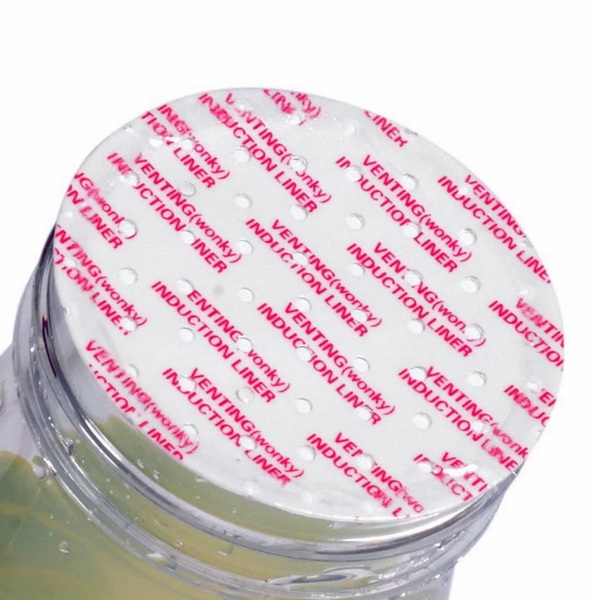
- Vented liners suit products that off-gas. Instant coffee usually does not need them.
Our technical team follows these steps with every customer.
1. Define the jar: material, neck finish and diameter.
2. Choose the backing: paperboard for flat, precise rims, or EPE foam for tolerance.
3. Choose the foil structure: aluminum thickness and barrier layers.
4. Pick the heat-seal layer for glass, PET or PP.
5. Check cap fit: size and cap-pressure consistency.
6. Run trial seals on your line. Then test leak, torque and peel force.
Request evidence of testing on your exact container. Liner compatibility should be validated on the actual bottle supplier and mold set.
- Choosing by diameter alone. The complete package matters.
- Oily or wet rims contaminate the bond.
- Wrong sealer settings. Too little power gives a weak bond. Too much burns the foil.
- Loose caps reduce contact pressure.
- Skipping shelf-life tests under humidity.
A typical scenario: a coffee brand packs in glass jars with slightly uneven rims. Intermittent leaks show up after transport. Moving to a 2-in-1 EPE foam liner improves contact across the rim. This is an illustrative scenario based on our general production experience, not a named customer result. Always run your own validation.
- 35 years of sealing-liner experience.
- ISO 9001 certified.
- 5 production lines in a 1,000 m² factory.
- 100+ clients worldwide.
- Customized sizes, structures and peel strength.
- Compatible with PE, PET, PP, PVC, PS, ABS, glass, ceramic, paper, aluminum foil and metal containers.
Ready to seal your coffee jars? Send us your jar specification and fill conditions. We will recommend a liner and provide free samples for testing. Visit our to request a quote.
1. What is the best induction liner for glass instant coffee jars?
A two-piece liner with a glass-compatible heat-seal layer. Paperboard suits flat rims. EPE foam suits uneven ones.
2. Can I use the same liner for glass and PET jars?
Only if it is a validated universal construction. Always test on both.
3. Wax or no-wax?
Wax helps the backing separate cleanly. No-wax foam liners suit applications where wax residue is a concern.
4. Do coffee jars need vented liners?
Usually not. Vented liners suit products that release gas.
5. Will induction sealing work with plastic caps?
Yes. It works through non-metallic caps, including PP, PE and PET
6. How do I make the seal easy to open?
Choose a Lift 'n' Peel or Ring Peel design. Validate the peel force.
- [Induction Seal Liner – Wanqi]
- [Induction Seal Liner Guide for PET, HDPE, PP & Glass – ObjectBrief]
- [Jar Sealing Technologies – Wolf Packing]
- [Packaging in Glass or PET When Considering Induction Seal – Sealeron]
- [How to Choose the Right Induction Heat Seal Liner – LinkedIn]
- Company facts: supplied by Shantou Wanqi Packaging Material Co., Ltd.