
- All
- Product Name
- Product Keyword
- Product Model
- Product Summary
- Product Description
- Multi Field Search
Views: 237 Author: Wanqi Publish Time: 2026-11-23 Origin: Site


Content Menu
● Pressure Sensitive Seals vs Induction Seals: The Essential Differences
● How Pressure Sensitive Cap Liners Work
>> Where Pressure Sensitive Liners Make Sense
>> Limitations Buyers Should Understand
● How Induction Seal Liners Work
>> Pressure, Heat, and Time Must Work Together
>> One-Piece and Two-Piece Induction Liners
● Match the Liner to the Container—not Just Its Diameter
● Choose According to Product Risk and Distribution Conditions
>> Dry Foods, Powders, and Supplements
>> Liquids, Cosmetics, and Lubricants
>> Pharmaceuticals and Regulated Products
● A Practical Validation Plan Before Full Production
>> Step 1: Define Acceptance Criteria
>> Step 2: Test Production-Representative Components
>> Step 3: Establish an Operating Window
>> Step 4: Challenge the Finished Package
>> Step 5: Document and Revalidate
● Troubleshooting Weak Seals Without Guesswork
● Compare Total Cost per Acceptable Package
● How Shantou Wanqi Supports Cap Liner Selection
>> 1. Are pressure sensitive seals suitable for liquids?
>> 2. Do induction seals work on glass containers?
>> 3. Are pressure sensitive liners tamper-evident?
>> 4. Can induction sealing extend shelf life?
>> 5. Does an induction seal remain effective after opening?
>> 6. Which liner is best for a high-speed packaging line?
At Shantou Wanqi Packaging Material Co., Ltd., we approach "pressure sensitive seals vs induction seals" as a packaging-system decision—not simply a comparison between two liner prices. The right cap liner must suit your product, container, closure, production line, and distribution conditions.
With 35 years of experience in sealing-material research, manufacturing, and sales, our ISO 9001-certified company operates five production lines within a 1,000-square-meter factory and serves more than 100 customers worldwide.
Our starting recommendation is straightforward: consider pressure sensitive liners for suitable dry-product applications requiring simple application without induction equipment. Consider induction seals when stronger barrier protection, leakage control, or a validated tamper-evident feature is required.
Neither option succeeds through material selection alone. Reliable sealing depends on how the complete package performs.

Pressure sensitive liners use an adhesive that bonds to the container rim under closure pressure. Induction liners use an electromagnetic field to heat aluminum foil, activating a compatible heat-seal layer against the container opening.
| Selection factor | Pressure sensitive seals | Induction seals |
|---|---|---|
| Bonding mechanism | Pressure-sensitive adhesive | Induction-heated foil and heat-seal layer |
| Application equipment | No induction sealer required | Induction sealing equipment required |
| Typical starting applications | Suitable dry powders, tablets, and granules | Suitable dry products and liquids |
| Barrier expectations | Construction- and application-dependent | Foil-based barrier potential; package validation required |
| Tamper evidence | Conventional removable foam versions should not be relied on alone | Can provide visible opening evidence when properly designed |
| Main process controls | Rim condition, pressure, adhesive compatibility, dwell | Pressure, heat, exposure time, compatibility, cooling |
| Investment considerations | Simpler equipment setup | Equipment, commissioning, and process-control costs |
These are selection guidelines, not universal performance guarantees.
*Suggested visual: A labeled cross-section showing adhesive bonding beside induction heat-seal bonding.*
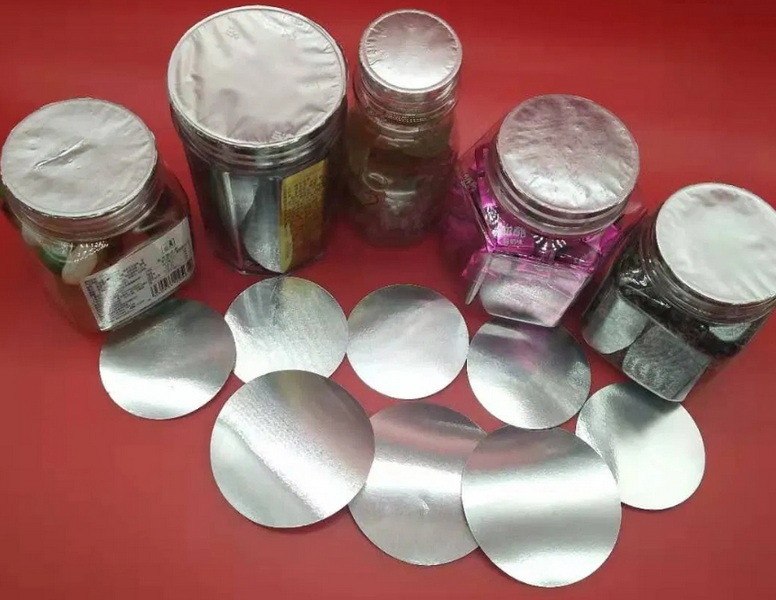
A pressure sensitive liner sits inside the closure with its adhesive face toward the container opening. Tightening the cap presses the liner against the rim. After the specified bonding period, the liner should remain attached when the cap is removed.
Pressure sensitive cap liners are worth evaluating when:
- The product is dry and chemically compatible with the adhesive.
- The container rim remains clean and dry during filling.
- The business wants to avoid installing induction equipment.
- The required protection can be demonstrated through package testing.
A dry spice jar illustrates the decision. Straightforward application may be attractive, but powder deposited on the rim can interrupt adhesive contact. Filling accuracy and rim cleanliness therefore matter as much as liner selection.
A liner that adheres visibly is not automatically leakproof, hermetic, or suitable for a moisture-sensitive product.
Do not assume pressure sensitive seals will perform with liquids, oils, volatile formulations, or aggressive chemicals. Obtain application-specific recommendations and test the actual formulation.
Also, allow the supplier-specified bonding period before assessment. Testing too early can misrepresent performance, while waiting longer cannot correct an incompatible adhesive or contaminated rim.
In induction sealing, the filled container is capped with a compatible foil liner inside the closure. The package passes beneath an induction head, whose electromagnetic field heats the foil.
Heat activates the sealing layer. Closure pressure maintains contact with the container rim while the bond forms and cools.
Three interacting variables govern the process:
1. Pressure establishes consistent contact around the sealing surface.
2. Heat activates the sealant without damaging the liner or package.
3. Time provides sufficient exposure at the chosen production speed.
Increasing power is not a universal solution to weak seals. An uneven rim, tilted cap, incompatible sealant, or contaminated opening can still produce failure.
A one-piece construction generally leaves the sealing membrane attached to the container after opening.
A two-piece construction separates during sealing, leaving an inner seal on the container and a backing component inside the cap. Whether that backing provides the required reclosure performance must be verified.
Select the construction according to both first-opening protection and use after opening.
One common purchasing mistake is specifying only the cap diameter.
An induction liner must have a sealing surface compatible with the container's sealing substrate. A liner selected for PE should not automatically be substituted for PET, PP, or glass.
Our broader application portfolio addresses packaging involving PE, PET, PP, PVC, PS, ABS, glass, ceramic, paper, aluminum foil, and metal. This does not mean every liner works with every material.
For each application, confirm:
- Exact container material, coatings, and surface treatments.
- Neck finish and sealing-rim geometry.
- Closure design and application-torque range.
- Liner diameter, thickness, and construction.
- Product chemistry and filling conditions.
"Universal induction liner" should be treated as a defined compatibility range—not a promise of compatibility with every package.
Metal closures and unusual container geometries also require equipment-specific assessment rather than assumptions based on standard plastic-cap applications.
Pressure sensitive liners may suit some dry-product applications. However, "dry" does not mean "insensitive."
Hygroscopic powders, aroma-sensitive ingredients, and oxygen-sensitive formulations may justify evaluating induction sealing. The choice should follow shelf-life requirements and package testing, not product category alone.
For liquid products, evaluate leakage, chemical compatibility, transport exposure, and consumer opening.
Induction sealing is often the stronger starting point when a bonded inner seal is needed, but the sealant must tolerate the formulation. Oils, solvents, and surfactants can change the compatibility question substantially.
Separate three questions:
- Is the material suitable for its intended contact conditions?
- Does the complete package provide adequate protection?
- Does the packaging meet applicable regulatory requirements?
ISO 9001 certification concerns quality-management systems. It does not independently establish pharmaceutical suitability, food-contact compliance, or approval of a particular package.
For certain U.S. OTC drug applications, FDA guidance specifically states that conventional pressure-sensitive polystyrene foam mouth seals are not effective tamper-resistant features when they can be removed and reapplied without visible evidence.
Induction sealing is not automatic regulatory compliance either. Package design, application, and identifying features still matter.
The most useful comparison happens on your actual packaging line.
Agree on what success means before requesting samples.
Criteria may include continuous seal coverage, acceptable opening force, leakage performance, appearance, and product protection throughout the intended shelf life.
Avoid an approval standard as vague as "the seal looks good."
Use the intended product, container, closure, and liner construction.
Include normal component variation where possible. A successful trial on unusually perfect samples does not establish robustness across routine production.
For induction sealing, vary power and line speed systematically while controlling closure application and head position.
Identify conditions producing undersealing, acceptable sealing, and overheating. Select settings within the acceptable region rather than at its edge.
For pressure sensitive liners, evaluate adhesive compatibility, closure pressure, rim cleanliness, and the specified bonding period.
Choose tests relevant to the distribution route and product risk.
These may include inversion, vibration, temperature conditioning, leakage testing, and opening assessment after storage. A short bench trial should not replace a justified shelf-life program.
Record approved components, equipment settings, inspection methods, and acceptance limits.
Reassess changes involving resin, closure geometry, liner construction, formulation, speed, or equipment.
Before replacing materials, investigate the failure pattern.
| Observed issue | Possible causes | First investigation |
|---|---|---|
| No adhesion | Incompatible liner, contamination, insufficient activation | Verify specification and inspect the rim |
| Partial circumferential seal | Uneven pressure, tilted closure, irregular rim | Examine cap seating and rim flatness |
| Scorching or deformation | Excessive heat exposure | Compare power and speed with validated settings |
| Inconsistent pressure-sensitive bond | Variable pressure, contamination, inadequate dwell | Check application consistency and test timing |
| Excessively difficult opening | Construction mismatch or unsuitable sealing conditions | Review opening requirements and trial records |
Change one variable at a time and document the result.
A repeatable diagnosis is more valuable than a temporary improvement achieved through several unrecorded adjustments.
The lowest liner price does not necessarily produce the lowest packaging cost.
Evaluate total cost as:
Liner purchasing + equipment ownership + labor + utilities + inspection + rejects + rework + leakage-related losses.
Divide that total by the number of acceptable finished packages.
For a small dry-product operation, avoiding induction equipment may be commercially sensible. For a liquid product exposed to demanding distribution, validated leakage protection may justify the added process investment.
These are illustrative decision scenarios, not customer case studies or guaranteed savings.
Also consider changeovers, operator training, spare parts, and the cost of maintaining multiple liner specifications.
Our portfolio includes pressure sensitive seal liners, no-wax induction seal liners, ring peel liners, instant coffee seal liners, universal induction seal liners, EPE foam liners, Lift 'n' Peel liners, one-piece seal liners, two-piece seal liners, vented liners, and aluminum foil sealing liners.
These categories describe different mechanisms, constructions, or opening features. They are not interchangeable.
For example, easy-open designs address user access, while vented constructions address controlled gas exchange. A vented package requires a different protection assessment from a nonvented barrier package.
Our role is to help narrow the material and construction options around the application—not to recommend one liner for every product.
Contact Shantou Wanqi Packaging Material Co., Ltd. with your product formulation, container material, neck drawing, cap specification, filling conditions, target speed, destination markets, and opening requirements. Request an application-specific sample recommendation and agree on validation criteria before placing a production order.
Conventional pressure sensitive cap liners are generally not the preferred starting point for liquid containment. Consider them only when the supplier confirms suitability and the complete package passes relevant testing.
Yes, suitable constructions can seal to glass. The sealing layer must be designed for the specific surface, and the container, closure, and equipment combination must be validated.
Do not assume so. Conventional removable pressure-sensitive foam liners should not serve as the sole tamper-evident feature where visible evidence of entry is required.
It can support shelf-life protection by providing an effective seal and barrier construction. Any extension must be demonstrated for the actual product and complete package.
The original bonded membrane is a first-opening feature. After removal, protection depends on the reclosed cap and any remaining backing liner. Test reclosure separately.
Choose the liner that consistently meets acceptance criteria at the required speed. Confirm cap application, induction capacity where relevant, inspection capability, and process stability through production trials.
1. Shantou Wanqi Packaging Material Co., Ltd. — Company information supplied for this article: experience, ISO 9001 certification, factory area, production lines, customer base, product portfolio, and application materials. These statements require company verification before publication; no public company-source URL was supplied.
2. Selig Group — [PHT: Guide for Induction Sealing]. Technical basis for pressure, heat, time, container-and-closure fit, cooling, and establishing a sealing operating window. [seliggroup]
3. Selig Group — [FAQs & Troubleshooting]. Technical support for weak seals, partial seals, contamination, torque, alignment, and excessive heat exposure. [seliggroup]
4. U.S. Food and Drug Administration — [CPG Sec. 450.500: Tamper-Resistant Packaging Requirements for Certain Over-the-Counter Human Drug Products]. Basis for the narrowly scoped discussion of removable pressure-sensitive foam seals and tamper-resistant package requirements. [fda]
5. Enercon Industries — [Understanding Induction Sealing]. Explanation of non-contact induction sealing and the distinction between freshness protection and appropriately designed tamper-evident packaging. [enerconindustries.my.site]
6. Google Search Central — [Creating Helpful, Reliable, People-First Content]. Editorial basis for useful technical guidance, transparent sourcing, and avoiding fabricated expertise or testimonials; not a guarantee of search rankings. [developers.google]