
- All
- Product Name
- Product Keyword
- Product Model
- Product Summary
- Product Description
- Multi Field Search
Views: 246 Author: Wanqi Publish Time: 2026-11-11 Origin: Wanqi


Content Menu
● Pressure Sensitive Seal Liner vs. Induction Seal Liner: Key Differences
● How Pressure-Sensitive Seal Liners Work
>> When Pressure-Sensitive Liners Make Sense
>> Where Pressure-Sensitive Liners Have Limitations
● How Induction Seal Liners Work
>> One-Piece vs. Two-Piece Induction Liners
● Container Compatibility: Why the Bottle Material Matters
● Which Seal Liner Is Better for Your Product?
>> Dry Foods, Powders, and Granules
>> Cosmetics, Oils, and Liquid Formulations
>> Pharmaceuticals, Pesticides, and Chemicals
● Tamper Evidence: Avoid a Common Packaging Mistake
● A Practical Six-Step Seal-Liner Validation Plan
>> 1. Define Acceptance Criteria
>> 2. Test Actual Production Components
>> 3. Control Rim Cleanliness and Capping
>> 4. Establish the Process Window
>> 5. Challenge the Finished Package
● What a Published Cosmetics Case Teaches Packaging Buyers
● Compare Total Packaging Cost, Not Just Liner Price
● Why Start Your Liner Evaluation with Wanqi?
>> 1. Is a pressure-sensitive liner suitable for liquid products?
>> 2. Do pressure-sensitive liners require a sealing machine?
>> 3. Can one induction liner seal both PET and PE bottles?
>> 4. Are all induction seals tamper-evident?
>> 5. Can the original seal be restored after opening?
>> 6. Why does an induction liner seal unevenly?
>> 7. Does an induction liner guarantee longer shelf life?
At Guangzhou Shantou Wanqi Packaging Material Company, we approach the question "Pressure Sensitive Seal Liner vs. Induction Seal Liner: Which Is Better for Your Packaging?" by examining the complete package—not simply the liner price.
Established in 1995, our company specializes in researching, developing, manufacturing, and supplying sealing packaging materials for cosmetics, pharmaceuticals, food, alcoholic beverages, pesticides, oils, and chemicals.
The practical answer is straightforward: pressure-sensitive liners can suit selected dry products when application simplicity matters. Induction seal liners are generally the stronger starting point for liquids, demanding barrier requirements, and packages requiring a validated first-opening seal.
Neither technology is universally better. The right choice depends on your formulation, container, closure, production process, and distribution conditions.

| Selection factor | Pressure-sensitive seal liner | Induction seal liner |
|---|---|---|
| Sealing mechanism | Adhesive bonds under closure pressure | Electromagnetic heating activates a heat-seal layer |
| Equipment | No induction sealer required | Requires compatible induction sealing equipment |
| Typical starting applications | Selected dry powders, granules, and tablets | Liquids, powders, foods, cosmetics, and other validated applications |
| Liquid containment | Generally not recommended as the primary liquid seal | Suitable when the complete package is validated |
| Barrier performance | Depends on construction; do not assume high-barrier protection | Foil construction can provide strong barrier performance |
| Tamper evidence | Should not be relied upon for regulated tamper evidence | Possible with an appropriately designed and validated system |
| Production priorities | Simple application and lower equipment investment | Controlled sealing performance and process monitoring |
This comparison provides an initial direction. It does not replace compatibility testing or product-specific qualification.
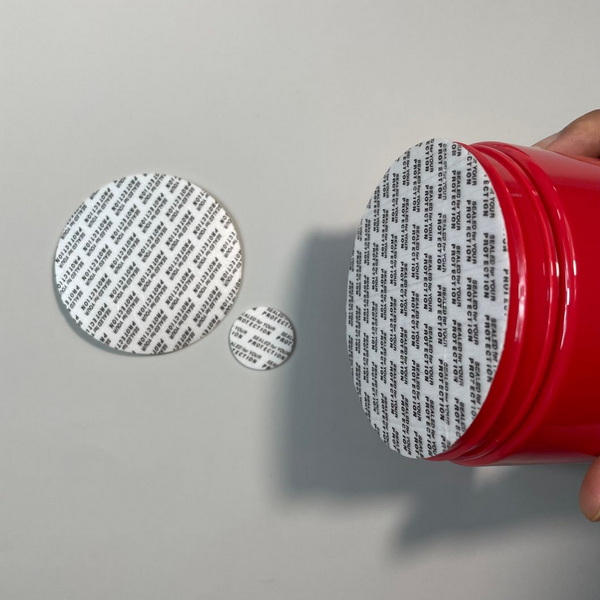
A pressure-sensitive seal liner typically combines a foam backing with a pressure-sensitive adhesive. When the cap is applied, pressure brings the adhesive into contact with the container rim.
On opening, the liner is intended to remain attached to the container mouth until the consumer removes it.
No induction heating is needed. However, reliable adhesion still depends on a clean, dry, even sealing surface, suitable closure pressure, and the liner supplier's application instructions.
These liners deserve consideration when:
- The product is dry and does not contaminate the sealing surface.
- Production volumes do not justify additional sealing equipment.
- Simple application is a major purchasing priority.
- The package does not depend on the liner for regulated tamper evidence.
- Product testing confirms adequate performance throughout the intended shelf life.
Examples may include certain seasoning powders, dry cosmetic powders, and other non-liquid products.
Their simplicity is useful, but it should not be mistaken for universal compatibility.
Free-flowing liquids, oily formulations, and demanding moisture-sensitive products require particular caution.
Product contact can interfere with adhesion. Dust on the rim can also reduce bonding, even when the contents are dry.
A printed message such as "sealed for your protection" does not establish tamper-evident performance. Packaging claims must reflect what the complete system demonstrably does.
An induction seal liner contains an aluminum foil layer and a heat-seal layer selected for the container surface. Other layers depend on the construction.
After filling and capping, the container passes beneath an induction sealing head. The electromagnetic field heats the foil. That heat activates the sealing layer, while closure pressure holds the liner against the container rim.
The bond develops as the package cools.
Three connected factors govern this process: heat, pressure, and time. Correct liner chemistry is equally important. More power cannot reliably correct an incompatible sealing layer.
A one-piece construction generally leaves the sealing membrane on the container without a separate backing intended to remain inside the cap.
A two-piece construction separates during sealing, leaving the foil seal on the container and a backing component in the closure.
That backing may support the package's reclosure function, depending on its design. It does not recreate the original induction seal once the foil has been removed.
Specify first-opening protection and after-opening performance as separate requirements.
*Suggested visual: Place a labeled cross-section here showing a pressure-sensitive liner, a one-piece induction liner, and a two-piece induction liner.*
Wanqi's stated application scope includes PE, PET, ABS, PS, PVC, and PP containers, alongside glass, ceramic, paper-based, aluminum-foil, and metal packaging.
That scope should not be interpreted as a claim that one liner works across every material.
For induction sealing, the heat-seal layer must suit the actual sealing surface. PET, PE, PP, and glass may require different constructions.
For pressure-sensitive liners, adhesion must likewise be assessed against the specific surface and finish.
Before recommending a liner, we would want to establish:
1. The container material and any surface coating.
2. The neck finish, opening diameter, and sealing-land width.
3. The cap design and intended application torque.
4. The product formulation and filling conditions.
5. The required opening experience and distribution environment.
Metal containers and metal closures require particular equipment assessment because conductive components can interact with induction heating. Paper-based and composite containers also require evaluation of the exposed sealing surface—not merely their general material description.
Pressure-sensitive liners can offer a straightforward solution for selected dry products.
However, "dry" does not necessarily mean easy to protect. A hygroscopic powder may require substantially greater moisture protection than a less sensitive granule.
If moisture uptake, aroma loss, or oxidation threatens quality, evaluate an induction-sealed package and verify the finished package's performance.
Induction sealing is generally the better starting point for free-flowing liquids and oils.
Creams and gels still need formulation-specific assessment. High viscosity alone does not prove compatibility with a pressure-sensitive adhesive.
Consider fragrance components, oils, solvents, and filling residue. These can affect sealing performance or material suitability.
For these applications, liner selection extends beyond preventing visible leaks.
Assess product-contact compatibility, required documentation, applicable regulations, transport conditions, and the consequences of failure.
Neither a generic "pharmaceutical-grade" label nor the presence of aluminum foil establishes compliance. Gas-generating formulations may also need a specifically engineered venting solution rather than an ordinary non-vented seal.
Tamper evidence means that opening or interference leaves an observable indication. It does not mean the package is impossible to open or alter.
Pressure-sensitive liners should not be treated as a substitute for a validated tamper-evident system.
An induction seal can support tamper evidence, but its suitability depends on the membrane, bond, package design, and applicable requirements.
Clean peeling, residue, or printed wording alone does not settle the question. Evaluate whether interference can be detected in the actual finished package.
For regulated products, have the complete packaging system and labeling reviewed against the relevant market requirements.
The most valuable comparison is not between two sample discs. It is between two complete, filled packaging systems.
Agree on measurable requirements before trials: leakage, opening force, seal continuity, appearance, shelf-life protection, and distribution resistance.
Avoid vague acceptance criteria such as "looks secure."
Use representative containers, closures, liners, and product.
Record supplier references and material specifications. A successful test with a similar bottle does not automatically qualify a new container.
Inspect for powder, oil, moisture, damaged rims, and uneven sealing surfaces.
Apply caps within the closure supplier's recommended and subsequently validated torque range. Excessive tightening is not a reliable remedy.
For induction sealing, control head position, conveyor speed, closure application, and power.
Identify a range that produces acceptable seals without scorching, wrinkling, or container damage. Avoid qualifying production from a single successful setting.
For pressure-sensitive liners, follow supplier requirements for application pressure and bonding time.
Use appropriate leak, handling, temperature, storage, and transport evaluations based on the product's risks.
Inspect induction seals after cooling. Include representative production variation rather than testing only ideal samples.
Record results and approval criteria. Reassess performance when the formulation, container, cap, liner, supplier, or line conditions change.
An equipment-supplier case study involving Belcorp's cosmetic cream illustrates why process control matters.
Liner wrinkling created stress and contributed to weak seals and leakage. The investigation examined interacting variables, including power, conveyor speed, closure torque, foil construction, and container materials.
The useful lesson is not that one machine setting suits all creams. It is that seal quality depends on the interaction between packaging components and operating conditions.
This is an external industry example, not a Wanqi customer testimonial or a claim about Wanqi's own test results.
Pressure-sensitive liners can reduce equipment requirements. Induction liners introduce equipment, setup, maintenance, and process-control costs.
However, purchasing decisions should also account for rejected units, rework, leakage, returns, and product loss.
A useful comparison is:
Total packaging cost per saleable unit = total relevant packaging and failure costs ÷ accepted units.
Use your own production data. Without comparable operating conditions and measured failure rates, a precise savings percentage would be speculation.
At Guangzhou Shantou Wanqi Packaging Material Company, our focus is sealing packaging materials rather than a one-size-fits-all recommendation.
Our company background dates to 1995, with application experience spanning multiple packaging sectors. The appropriate next step is to match that scope to your specific product and package.
When contacting us, provide:
- Product type and relevant formulation characteristics.
- Container material, neck dimensions, and samples.
- Closure specifications and samples.
- Filling conditions and available sealing equipment.
- Destination markets and required supporting documentation.
- Desired peel behavior, appearance, and first-opening protection.
Request a liner recommendation and sample evaluation before committing to volume purchasing. A suitable specification begins with the package requirements—not simply a diameter and price.
Generally, it should not be the default primary seal for free-flowing liquids. An appropriately specified induction liner is usually the better starting point, subject to filled-package testing.
They do not require an induction sealer. They still require correct placement, appropriate closure pressure, clean sealing surfaces, and compliance with supplier instructions.
Do not assume so. Some constructions may support multiple substrates, but compatibility must be explicitly confirmed and validated for each container.
No blanket claim is appropriate. Evaluate the liner and complete package for detectable opening or interference and any applicable regulatory requirements.
Generally, neither type is intended to recreate its original first-opening seal after removal. A closure backing may assist reclosure, but that is a different function.
Possible causes include incompatible materials, contaminated or uneven rims, inconsistent cap torque, incorrect head alignment, and an unsuitable heat-input or dwell-time range.
No. It can improve the package barrier, but shelf life also depends on the formulation, container, closure, storage conditions, and validated finished-package performance.
1. Shantou Wanqi Packaging Material Company — "About." Company establishment and sealing-material business background. [wanqipk]
2. interpack China — "SHANTOU WANQI PACKAGING MATERIAL CO., LIMITED." Company profile, industry applications, and pressure-sensitive liner description. [interpack-cn]
3. MJS Packaging — "Closure Liner Guide." Pressure-sensitive liner construction, application limitations, and induction sealing compatibility. [mjspackaging]
4. The Cary Company — "Pressure Sensitive Liners vs. Heat Induction Liners." Comparative applications and limitations. [thecarycompany]
5. Enercon Industries — "Induction Cap Sealing Basics: How it Works & Keys for Success." Induction heating, bonding, and two-piece liner operation. [enerconind]
6. Enercon Industries — "Get Consistent Seals: Dial In Your Induction Sealing Window." Alignment, speed, torque, and operating-window development. [enerconind]
7. Enercon Industries — "Troubleshooting Induction Seals: Container & Liner Material." Seal-layer and container compatibility. [enerconind]
8. Enercon Industries — "Induction Sealer Provides Wrinkle Free Solution for Cosmetic Creme." Published Belcorp case and process-development findings. [enerconind]
Hot Tags: China, Global, OEM, private label, manufacturers, factory, suppliers, manufacturing company